
Memory, with a source trail.
Mousa is an experimental memory instrument: local-first retrieval and context assembly for agents and other software. Recover the right source. Preserve what changed. Deliver context you can audit.
Knowledge does not merely accumulate. It fragments, conflicts, ages, and loses its source context.
Search returns matching text without showing why it was selected, whether it remains current, or what it replaced. Agent systems pay a direct cost when retrieval sends more context than the task requires.
Sources drift apart
Long-lived collections become duplicated, contradictory, and detached from where they came from.
Why this passage?
Generic pipelines often hide whether a result is current, what it superseded, and how it was ranked.
Context overruns
Unbounded retrieval inflates token budgets and buries the evidence a task actually needs.
Nine stages. One responsibility each. A visible boundary between every one.
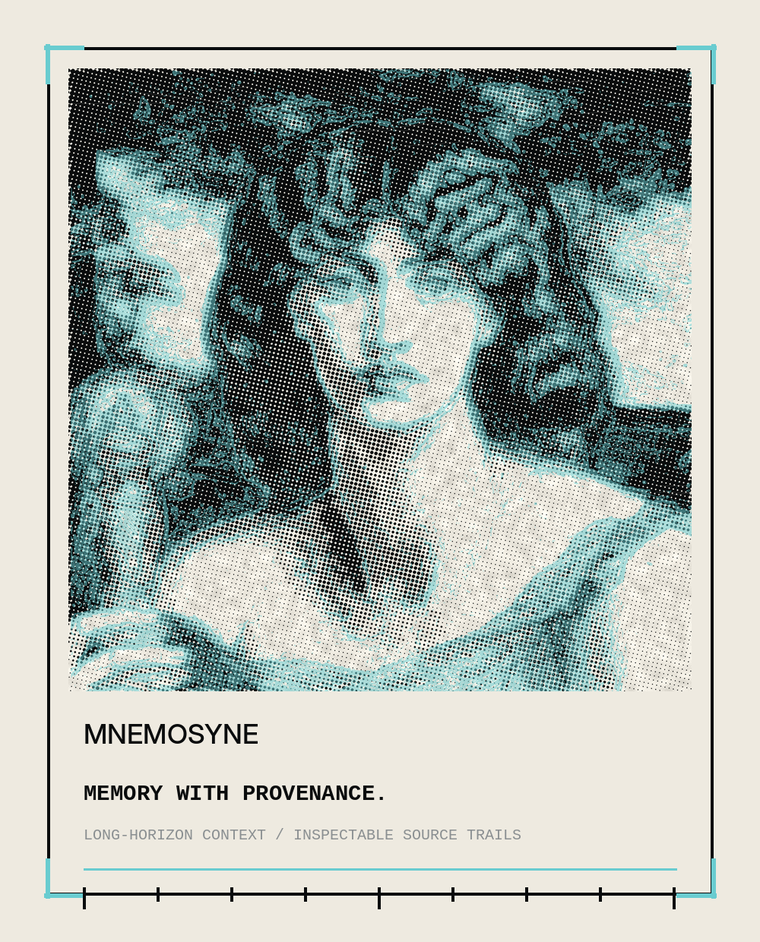
Mousa is the Ancient Greek singular of Muse. In Greek mythology, Mnemosyne — the titan goddess of memory — is the mother of the nine Muses. The name gives the project its organizing idea: durable memory is not one act. Sources move through nine explicit stages before they become usable context.
Ingest
Register source material with its origin, identity, and policy metadata.
Normalize
Convert input into a stable representation while preserving the original source.
Segment
Produce deterministic, addressable chunks.
Index
Build portable lexical and optional semantic search structures.
Match
Retrieve candidate evidence for a request.
Rank
Order candidates using inspectable relevance and policy signals.
Verify
Check authority, freshness, sensitivity, conflicts, and supersession.
Trace
Record how evidence moved through retrieval in a durable Source Trail.
Pack
Assemble the selected evidence within an explicit context budget.
The pipeline can be tested stage by stage, and no single model, provider, or harness owns the result.

Every context packet keeps the record of how it was produced.
A Source Trail is a durable record, not a score presented as an explanation. It retains enough evidence to inspect what was selected, what was rejected, and why.
- Request and actor identity
- Candidate generation and policy filters
- Ranking stages and selected chunks
- Source paths, hashes, and freshness
- Supersession and transform decisions
- Final packet hash and export
Stable identifier: R-2048 · trace-9f3c…
One portable core. Narrow interfaces.
Mousa is designed to be called primarily by agents, harnesses, CLIs, SDKs, and APIs. A human-facing application provides observability, policy control, provenance inspection, correction, and export — not a generic chat shell.
Local-first. Source-linked. Lean. Inspectable.
Local-first
The baseline works without a hosted service.
Source-linked
Retrieved context retains durable links to its evidence.
Lean
The smallest reliable components; no mandatory services.
Portable
Ordinary files, SQLite, documented protocols, CPU-only baseline.
Inspectable
Ranking, filtering, transformation, and assembly are traceable.
Deterministic
Stable identities, hashes, manifests, and truncation rules.
Token-aware
Retrieval quality and context cost measured together.
Provider-independent
No model, accelerator, harness, or database owns the store.